
- OUR SERVICES
Cloud, DevOps & AIOps
We automate your infra, releases and we make alerts mean something again.
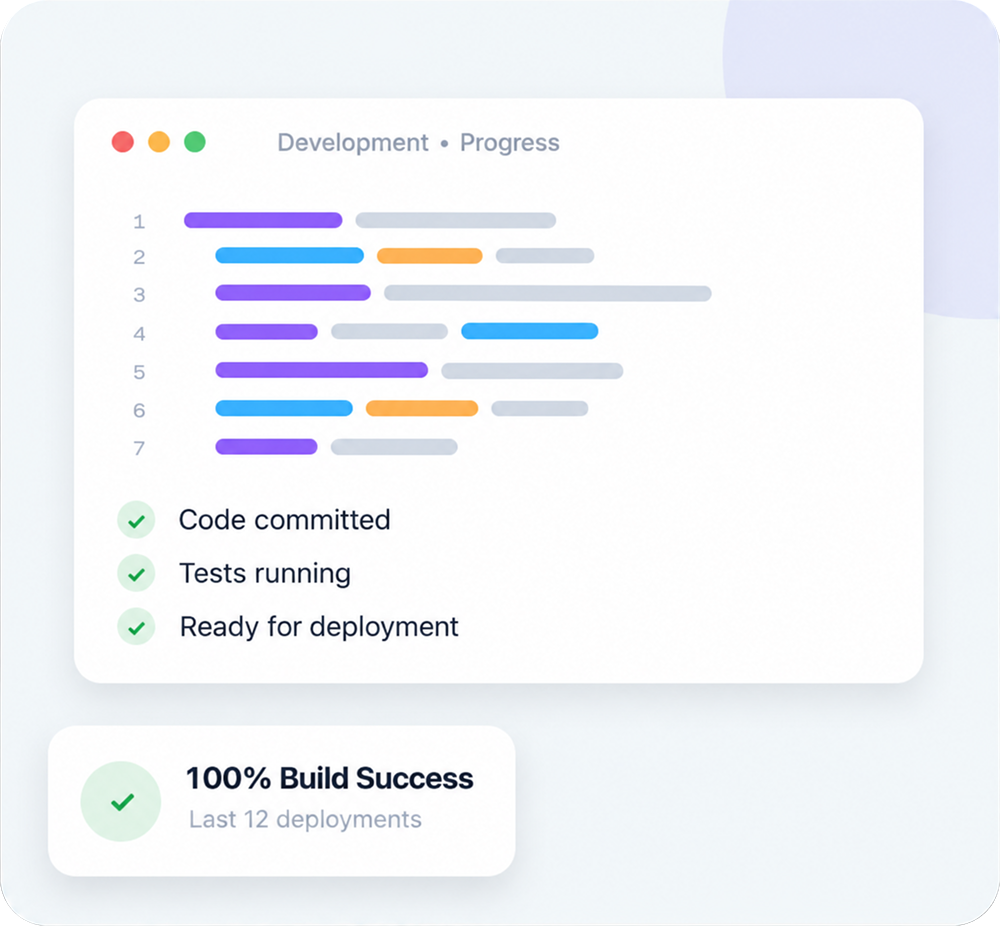
What we do
Two connected services under one roof. DevOps covers how software gets built, tested, deployed and run in the cloud: containers, pipelines, infrastructure as code, and the cloud architecture underneath it all. AIOps covers what happens after it’s live: applying machine learning to your operations data so the right alert reaches the right person, instead of everyone drowning in noise.
Most vendors sell these as separate practices. We don’t, because they’re more connected than they look. A clean DevOps setup produces exactly the kind of structured, consistent telemetry that makes AIOps actually work, and a team that isn’t fighting fires from bad deployments has more room to fix the alerting problem properly.



Cloud & DevOps.
why it matters – If a release takes a weekend and three people on standby, your team will release less often. Less often means bigger, riskier releases. We break that cycle.
Cloud or on-premise - your choice
We’re not tied to one vendor. AWS, Google Cloud, Azure, Hetzner, or your own data centre — we work with the infrastructure you have or want, not the one that’s easiest for us to sell. Infrastructure as Code is standard on every engagement, not an optional add-on, so your environment is documented, reproducible and never a hand-built snowflake nobody can safely rebuild.
Included .
- microservices design and modernisation of conventional applications
- Docker containerisation, Kubernetes and Docker Swarm orchestration
- CI/CD pipelines and blue/green deployments
- Infrastructure as Code as standard practice, not an extra
- multi-cloud and on-premise deployment across AWS, Google Cloud, Azure, Hetzner and private data centres
- highly available and disaster-recoverable architectures
- serverless where it fits
- secure networking and deployment
- cloud cost optimisation
- monitoring, logging, alerting and runbooks
Tools .
- Git.
- Maven
- JUnit
- JaCoCo
- SonarQube
- Docker
- Kubernetes
- Terraform
- Ansible
- Selenium
Typical results .
deployments move from weeks to same-day, failed deployments roll back automatically instead of causing an outage, and cloud bills usually drop once idle and oversized resources come out.
AIOps .
why it matters – The average IT operations team now receives 500 to 1,200 alerts a day. Most are noise. The real incident is somewhere inside that pile, and by the time someone finds it, the customer has already noticed.
Buying a monitoring tool doesn’t fix this. Engineering toil has actually gone up since 2024 despite heavy investment in AI-powered monitoring, and 58% of IT professionals say they struggle to interpret what their ML-driven tools are telling them. The tools got smarter. The workload didn’t get lighter.
What AIOps actually does
- Event correlation Groups hundreds of related alerts into one incident, so you're looking at a problem rather than a symptom list.
- Noise suppression Learns your normal baselines and stops paging people about things that are fine. Well-implemented systems cut alert volume by 90 to 95%.
- Root cause analysis Maps the dependency chain so you find the failing component instead of the loudest one.
- Anomaly detection Flags behaviour that deviates from baseline before it becomes an outage.
- Predictive alerting Surfaces risks early, so incidents get prevented rather than resolved.
- Auto-remediation Runs the runbook automatically for known, well-understood failures.
Documented deployments show MTTR reductions in the 40 to 60% range, with detection speed improving around 35%. Some published cases go much further.
How we work
About one in three teams fail when they roll out full autonomous remediation. Almost always for the same reason: they turned it on before they trusted it. We don’t do that.

Instrument first.
AIOps is only as good as your telemetry. If logs, metrics and traces are patchy, we fix that before anything else. 41% of enterprises hit legacy integration problems here, so we scope it honestly rather than assuming.

Correlation and noise reduction only.
Get the alert volume down and prove the correlation is right. This alone is usually the biggest single win, and it carries no risk.

Shadow mode, minimum two weeks.
Auto-remediation runs in parallel with production, logging every action it would have taken without executing any of it. Then we check those recommendations against what actually happened.

Enable remediation gradually
starting with the most routine, most reversible runbooks. Each one has a rollback path and a kill switch.

Keep humans in the loop
for anything that touches customer-facing systems or data.
The point of AIOps isn’t an autonomous NOC. It’s an on-call engineer who gets woken up three times a month instead of thirty, and who knows what’s wrong when they open the laptop.
Tell us your challenge.
A system that keeps breaking. An ERP that doesn’t reach the shop floor. Trading partner data arriving as PDFs. Alerts nobody can keep up with. Roles you can’t fill. An AI project stuck at pilot. Send us two lines and we’ll tell you straight away whether we can help.


Together: Our Wisdom, Your Success.



Have any Question to our team?
1. Which cloud do you work with?
Any of them. AWS, Google Cloud, Azure, Hetzner, and on-premise infrastructure, depending on what you already run or want to move to.
2. Is Infrastructure as Code included or extra?
Included, by default, on every engagement.
3. What is AIOps?
AIOps (Artificial Intelligence for IT Operations) is the application of big data, machine learning (ML), and artificial intelligence (AI) to automate and enhance IT management, monitoring, and service delivery
4. How long does it take?
Pilot deployments typically run six to eight weeks, with measurable MTTR improvement inside the first 30 days.
5. Do we have to replace our monitoring tools?
No. AIOps usually sits above the tools you already run.